


By Urban Kopitar - Sales Enablement & Marketing Specialist
How Dynafit achieved a 209% uplift in AI citations and stronger brand mentions with expert human content
The challenge: AI is taking over product discovery
Product discovery is shifting away from brand websites and into AI assistants. Shoppers who used to land on dynafit.com to browse category pages and compare products now ask ChatGPT, Gemini, Perplexity, or Google AI Overviews first, often forming opinions and shortlisting products before they ever visit a brand site.
Most importantly, people (and the LLMs answering them) are looking for the same thing: real-world experience and recommendations from people who have actually tested the product.
That is why adding content that showcases personal experience is the key to becoming visible in AI search.
For a mountain sports brand like Dynafit, this matters. Many buying decisions depend on practical questions that go beyond standard product descriptions: how a boot feels on long ascents, how stable a trail running shoe is on technical terrain, whether a race vest prevents flask bounce, or how a wind jacket performs over a backpack during fast movement.
Together with GUURU, Dynafit ran a case study to test whether expert human answers published directly on product pages could improve AI visibility.
The measurement was supported by common AI visibility tracking tools across Peec.ai, Searchable, and Profound, focusing on whether Dynafit was mentioned in AI-generated answers and whether dynafit.com was retrieved as a cited source.
The results showed clear growth in both key areas measured: AI citations and brand mentions.
Across the five tested products, source usage of dynafit.com increased from 23% to 73% overall. In Germany, source usage increased from 25% to 82%. In the US view, it increased from 22% to 64%.
Brand mentions also improved. Average Dynafit mentions across all tested products increased from 76% to 91% overall.
| Metric | Baseline | Post-implementation | Increase |
|---|---|---|---|
| Global AI source usage | 23% | 73% | +209% |
| Germany source usage | 25% | 82% | +227% |
| Average brand mentions | 76% | 91% | +20% |
This case study shows how expert human content can turn product pages into stronger assets for both the shopper experience and AI-generated product discovery.
Case study objective: improving Dynafit’s AI visibility with expert product content
Dynafit wanted to test whether expert-led product content could improve AI visibility on selected product detail pages.
The case study focused on two AI visibility signals:
- The first was whether Dynafit was mentioned in AI-generated answers.
- The second was whether dynafit.com was used as a cited and retrieved source in those answers.
The expert content was published via GUURU’s Community Content module directly on the selected product pages.
Test setup: how we measured expert content's impact on AI visibility
The test measurements were conducted between 2 March and 13 April.
Five selected Dynafit product pages were included:
- Blacklight Boot Men
- Dynafit Ultra 100 v3
- Dynafit Trail Graphic
- Dynafit DNA 8
- DNA Race Wind Jacket
For each of the five products, three predefined questions were used as prompts in the AI visibility tracking tools. Each prompt was tested in both German and English, resulting in a total of 30 tracked prompts: 5 products × 3 questions × 2 languages. The results presented in the following sections are based on a before-and-after comparison, measuring AI visibility before and after Community Content was implemented on the respective product pages.
The two main KPIs were:
- Visibility/mentions: the percentage of AI-generated answers mentioning Dynafit.
- Source retrieval by domain: the percentage of AI-generated answers using dynafit.com as a source.
This distinction was central to the case study.
Mentions show whether the brand appears in AI-generated answers. Source retrieval shows whether AI systems are actually using dynafit.com as part of the answer’s evidence base.
The expert answers were published directly on the relevant product detail pages, making them part of the product-page experience for shoppers and part of the indexable content available to search and AI systems.
How GUURU turned Dynafit’s product expertise into AI-visible content
The case study combined Dynafit’s community and its product knowledge with GUURU’s Community Content workflow to turn authentic expertise into reusable, AI-visible content on relevant product pages.
GUURU supports two complementary approaches to creating this content.
Proactive content creation: Filling high-value content gaps
Proactive content creation focuses on the buying questions that product pages do not yet answer. For Dynafit, relevant product questions were provided to members of the expert community, who contributed authentic answers based on their experience with the products. These answers were then prepared for publication on the corresponding product pages.
This approach enabled Dynafit to add targeted expert content around product-specific questions that matter to shoppers and can support visibility in AI-generated answers.
Organic content generation: Turning shopper conversations into reusable content
Organic content generation builds on live advice conversations between shoppers and community experts. When users ask relevant product questions, GUURU can identify valuable insights from these conversations and transform the strongest answers into reusable, AI-visible on-page content.
This creates a continuous source of content grounded in real shopper interests, purchase considerations, and practical product experience.
Across both approaches, the content does not come from generic copywriters or synthetic AI voices. It is contributed by members of Dynafit’s own expert community, including product users, athletes, and brand fans with hands-on experience using the products.
The result is a layer of authentic expert content directly on Dynafit’s product pages, answering the detailed questions shoppers ask before buying and providing AI systems with product-specific information they can retrieve and use in helpful answers.
The results: significantly more AI citations, stronger source authority, and higher brand mentions
The case study showed clear improvement in both AI citations and mentions.
The strongest increase could be observed in the source usage of dynafit.com. After the expert content was published and indexed, AI systems used Dynafit’s own domain much more often when answering relevant product questions.
Brand mentions also improved overall, especially where the baseline was not already extremely high.
AI citations of Dynafit more than tripled, with a 209% relative uplift

Across all five tested products, source retrieval by domain increased significantly.
showing that once expert content was live and indexed, dynafit.com became much more likely to appear as a source in AI-generated answers.
Overall citations of dynafit.com within the tested prompt set increased by 209%, effectively more than tripling visibility in AI-generated responses.
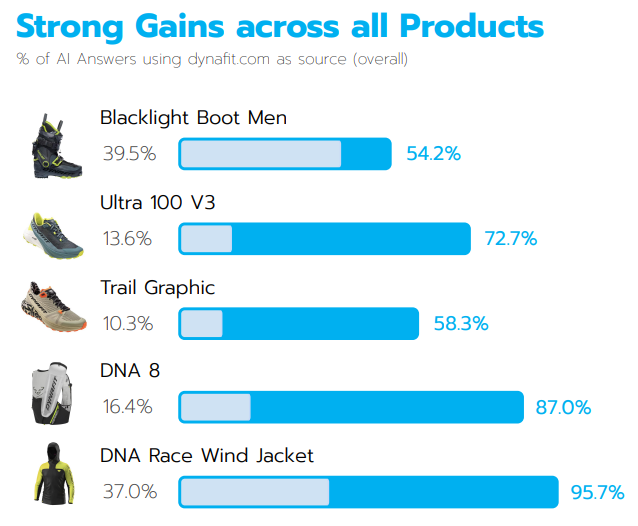
Germany, in particular, showed exceptional improvements:
- Ultra 100 v3: 20% to 90%
- Trail Graphic: 5% to 91%
- DNA 8: 20% to 90%
- DNA Race Wind Jacket: 38% to 91%
These results show that expert-led human content did more than simply add information to product pages.
It substantially increased the likelihood that Dynafit’s own pages would be retrieved and cited in AI-generated product recommendations and answers.
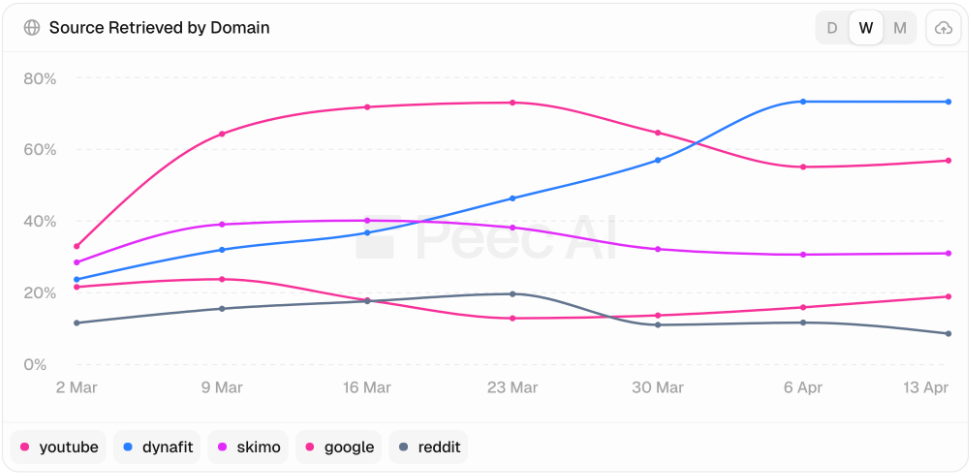
Towards the end of the case study, Dynafit was the dominant page in terms of source retrievals, even higher than Google, YouTube, or Reddit.
Dynafit gained more mentions in product-level AI answers
Dynafit mentions also improved across the tested products.
Average Dynafit mentions increased from:
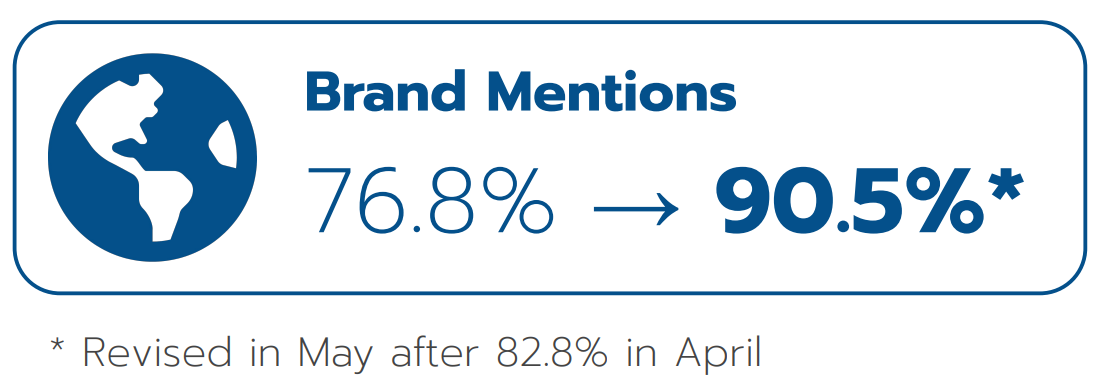
- 76% to 82% overall
- 87% to 93% in Germany
- 68% to 72% in the US
At the product level, several products showed gains:
- Blacklight Boot Men: 82% to 87%
- Ultra 100 v3: 68% to 86%
- DNA 8: 73% to 87%
After reviewing the data again a month later, in May, Dynafit overall average mentions grew to 91%.
Overall, the quantitative results show improvement on both dimensions: Dynafit was mentioned more often, and dynafit.com became significantly more likely to be used as a source.
AI assistants started using Dynafit’s own content to generate the answer
Beyond the KPI shifts, the strongest qualitative proof came from what happened inside the AI-generated answers themselves.
Before the expert content was added, Dynafit was often not used as a source, even when the product was being discussed.
After the content was published, AI-generated answers began to:
- Cite dynafit.com directly
- Use Dynafit product pages in the source list
- Reproduce distinctive descriptions that came from the expert answers
This matters because it shows that the AI answers were not only mentioning the brand. They were retrieving and using the newly added expert content from dynafit.com.
Example: AI answers started citing Dynafit’s Speedfoam content
One of the queries we tested in our prompt set was a question: “How soft and comfortable is the new Speedfoam cushioning on ultra-distance runs?”
Before Community Content:
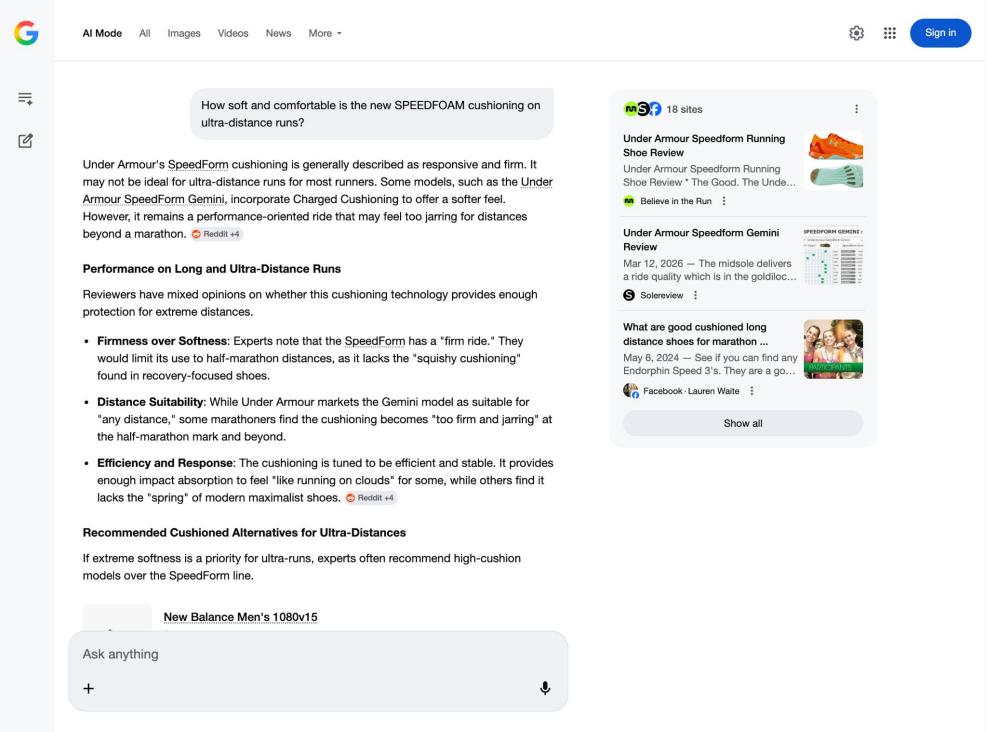
Before Community Content was implemented, the same query failed to mention or cite Dynafit and instead directed the buyer toward an Under Armour product, one of Dynafit’s competitors.
After adding Community Content:
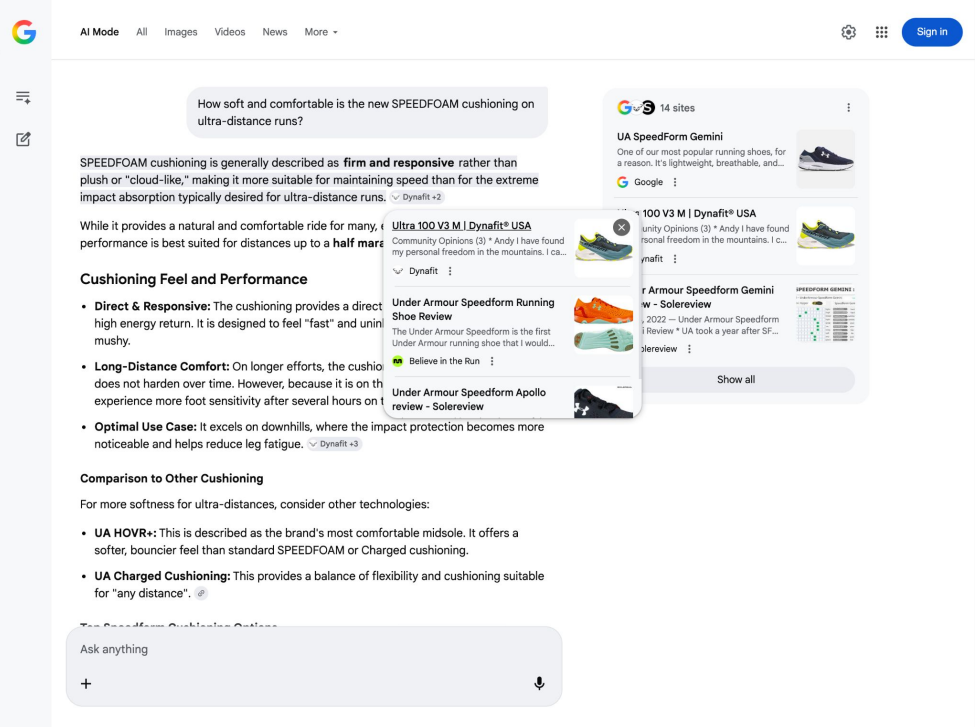
After Community Content was added, the same query produced a very different result. Dynafit’s SPEEDFOAM cushioning was mentioned accurately, dynafit.com was cited as the source, and the answer drew directly from one of the published Community Opinions.
How did adding the Community Content produce a significant increase in AI visibility for Dynafit
The case study succeeded because it introduced the kind of content AI systems need in order to answer product-level questions well. The expert content was specific, experience-based, product-relevant, and long-tail. It was directly tied to the page being retrieved, and it was written by real human experts rather than synthetic generic copy.
This is particularly important in AI search. Generic AI-generated FAQ content often repeats what is already available elsewhere. It tends to be broad, templated, and weakly differentiated.
By contrast, Dynafit’s expert content included nuanced details from real product experience, such as:
- Stride feel on long ascents
- Cuff movement and downhill balance
- Fit changes versus previous shoe versions
- Flask bounce in race vests
- Backpack interaction during fast movement
- Realistic warmth and packability tradeoffs in mountain conditions
For shoppers, this content helps answer practical questions before purchase. For AI systems, it creates a clearer and more useful source of product-level information. For Dynafit, it strengthens the role of its own product pages in AI-generated answers.
How does Dynafit benefit from this?
At the start of this case study, we described the core challenge: product discovery is moving off dynafit.com and into AI assistants, where shoppers form opinions before ever reaching a brand site.
The results show that Dynafit can put its own expertise in front of shoppers at the exact moment AI assistants are shaping their opinions. By publishing expert answers directly on its product pages, Dynafit is now more frequently cited, mentioned, and used as a source by AI assistants generating product recommendations.
In practice, this came from publishing high-value expert content directly on product pages, which scaled long-tail question coverage and turned real product knowledge into content AI systems could index.
This is also why the approach works. AI assistants favor content grounded in genuine, real-world experience over generic or synthetic text. Community Content is written by people who actually use the products, so it carries the specific detail and authenticity that LLMs look for when deciding what to cite and recommend. Synthetic, mass-produced content lacks that signal, which is exactly what makes authentic answers stand out as a source.
More broadly, the results show a clear opportunity for any brand: when product pages answer the detailed questions shoppers and AI systems are already asking, they become stronger assets for discovery, trust, and conversion, with the brand's own content shaping how AI assistants describe and recommend its products.
What's next for Dynafit: scaling content across the full online store
This case study followed the natural rollout process: test on a small set of products, validate the effect, then scale.
With a 209% citation uplift confirmed across the five tested products, the next steps are clear.
Dynafit will now scale Community Content across all product pages and seed additional content on strategic topics.
Because the content comes from a community of expert users rather than a fixed copywriting team, the approach scales with the store.
The mechanism that worked for five products applies directly across all page types and products.
Improve your AI visibility with Community Content
Just like Dynafit, you can turn real product experience into content that AI assistants cite, trust, and recommend. Here's where to start.
Try it on your own shop
Simulate the results yourself with our interactive demo. No install required.
Launch the demo →Get the summary
Download a short PDF recap of the Dynafit case study to share and discuss with your team.
Download the recap →Talk to us
Book an informative call with our sales team to explore what's possible for your brand.
Book a call →Common questions about AI citations and visibility
What is the difference between brand mentions and citations in AI search?
Brand mentions measure how often a brand appears in AI-generated answers, while citations (also called source retrievals) measure how often AI systems use the brand's own pages as a referenced source. A brand can be mentioned without being cited. In the Dynafit case study, mentions rose from 76% to 91% and source usage of dynafit.com rose from 23% to 73%.
Why do AI assistants cite human expert content over AI-generated content?
AI assistants favor content grounded in real, first-hand experience because it carries specific, verifiable detail that generic or synthetic text lacks. Answers from people who actually use a product describe details like fit, stability, and real-world performance, which are the signals AI systems rely on when deciding what to cite and recommend.
How can an ecommerce brand get cited more often in AI-generated answers?
The most reliable approach is publishing specific, experience-based content directly on the product pages AI systems retrieve. Answering the detailed, long-tail questions shoppers actually ask, grounded in real product expertise, gives AI assistants product-level information they can index and cite. Dynafit applied this on five product pages and saw a 209% increase in citations.
How is a brand's AI visibility measured?
AI visibility is tracked with tools that test how often a brand is mentioned in and cited by AI assistants across a defined set of questions. Two signals matter most: how often the brand appears, and how often its own domain is used as a source. Results are compared before and after content changes to show impact, as in the Dynafit study's set of 30 tracked prompts across five products in two languages.
Follow us on: