

By Julie Lamotte - GEO & SEO expert.
From discovery to execution: Why agentic AI is the new frontier of commerce
In 2026, we are moving from "generative search" (discovery) to agentic commerce (execution). Success is no longer just about being found; it’s about being "hired" by AI agents. To win, brands must optimize for the Agentic Commerce Protocol (ACP) and provide "machine-readable trust" through human-led data like expert opinions through GUURU.
The shift: From "knowing" to “doing”
Our previous deep dives into the UCP protocol and GEO focused on how brands get discovered. But discovery is only half the battle. According to a 2026 comprehensive survey, we have entered the age of Agentic AI, systems that don't just answer questions, but possess "agency": the ability to reason, use tools, and complete multi-step goals autonomously.
As this MIT research explains, while generative AI creates, agentic AI completes. In retail, this transforms the "customer" from a human browsing a site to an AI agent interacting with a brand’s backend to find, negotiate, and buy.
The 3 layers of agentic commerce
Winning in this "Machine-to-Machine" economy requires a strategy that spans three distinct layers. If you miss one, you are invisible to the autonomous buyer.
| Layer | Strategic focus | Primary success metric | Key infrastructure |
|---|---|---|---|
| Discovery | Visibility & catalog | AI citation rate | GEO & structured data |
| Transaction | Execution & payment | Agent fulfillment rate | ACP & API accuracy |
| Trust | Decision confidence | Recommendation bias | The trust factor* |
*Learn more about this in our deep dive: The trust factor in e-commerce
1. The Discovery layer (AEO & GEO)
This is the base of the pyramid. Can AI systems find your products? This requires machine-readable PDPs, high-fidelity product feeds, and structured technical content that allows AI to index your catalog without guesswork.
2. The Transaction layer (ACP)
This is the execution phase. The Agentic Commerce Protocol (ACP) , an open-source standard co-developed by OpenAI and Stripe, serves as the secure "handshake." It allows agents to authorize payments and check inventory without a human ever clicking a "checkout" button. This is the "zero-UI" revolution.
3. The trust layer (The "Un-AI-able" advantage)
This is where most brands fail. AI agents are rational but skeptical. When an agent compares two jackets with identical specs, it looks for “information gain” nuanced, human-experienced data that isn't in a standard feed.
Why agentic shopping needs human expertise
As the OECD 2026 Landscape Report points out, the more autonomous AI becomes, the more it requires "human-in-the-loop" verification.
AI agents can process price and weight, but they struggle with:
- "Does this sport e-commerce gear run true to size?"
- "Is this bike suitable for a beginner, despite the pro specs?"
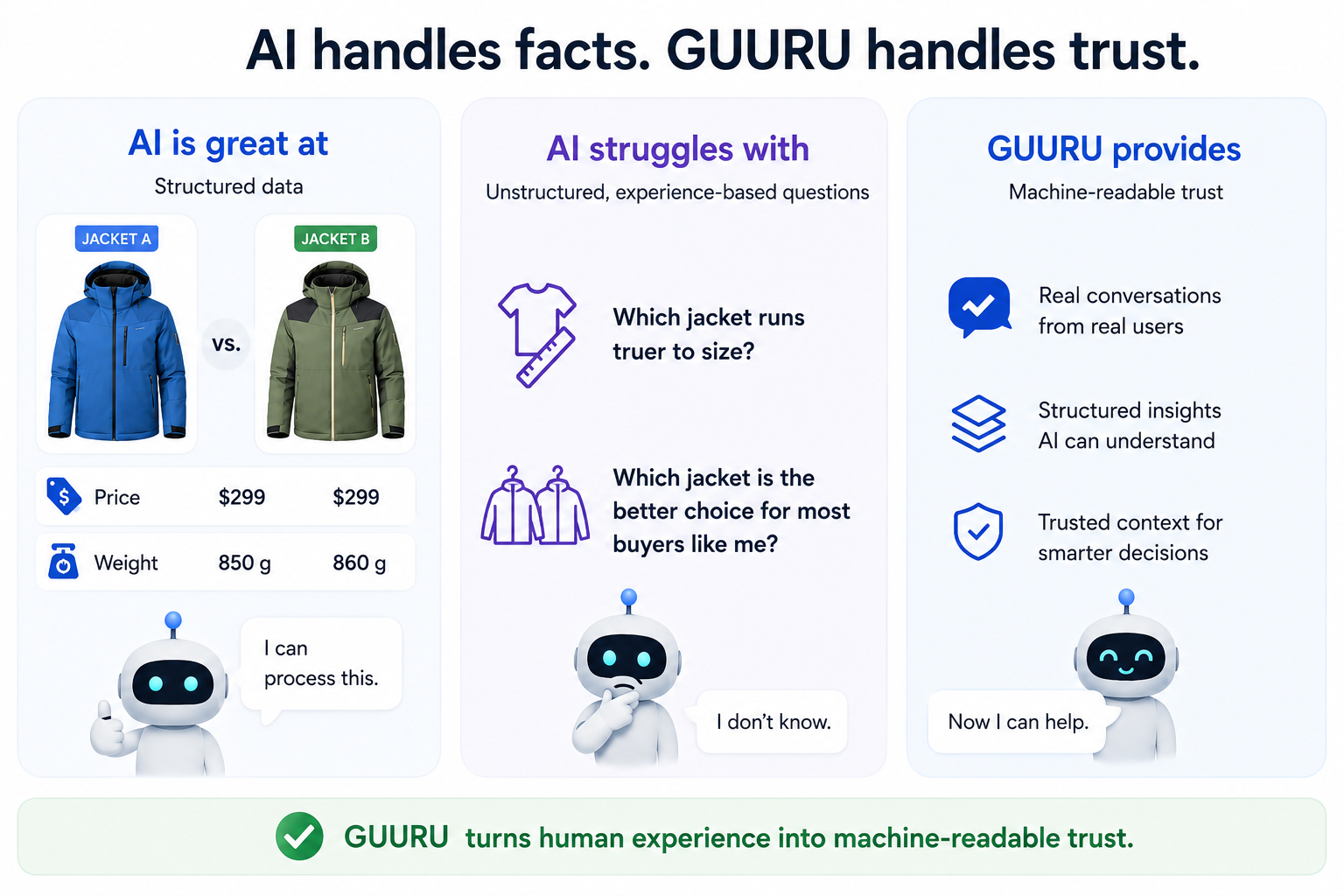
For instance, GUURU provides the "machine-readable trust" that fills this gap. By turning real-world customer interactions into indexable community content questions, GUURU gives AI agents the confidence to choose your brand. When an AI agent analyzes real-world discussions from brands like Canyon or Polo Motorrad, it identifies the human insights and trust signals necessary to verify a major purchase decision.
Agent Engine Optimization (AEO): How to prepare
To succeed in the "post-click" world, retailers must optimize for "agents" as much as they do for "Google bots."
- Prioritize "decision-driven" data: Move beyond flowery prose. Use attribute-value pairs that agents can ingest.
- Bridge the experience gap: AI content alone isn't enough. As we discussed in AI content vs UPGC, the combination of machine efficiency and human user generated content is the ultimate competitive moat.
- Focus on fulfillment: Success is no longer "traffic"—it's providing the data accuracy that allows an agent to close the sale.
The $5 trillion imperative: Is your store agent-ready?
By 2030, McKinsey research projects that Agentic Commerce will orchestrate between $3 trillion and $5 trillion in global retail spending. We are currently in the watershed moment where being "discoverable" is no longer the competitive ceiling: it is the floor. To capture your share of this shift, your brand must offer the decision confidence that autonomous agents require.
Don't let your brand get left behind in the "zero-UI" economy. Bridge the gap between machine efficiency and human experience with the world's leading community-led trust platform.
Book a demo with GUURU today and start building the "machine-readable trust" your brand needs to win the future of commerce.
Julie Lamotte, SEO & GEO manager
I work as an SEO Manager and love understanding how people search and interact online.
Being part of the GUURU community allows me to help users find the information they need while improving digital experiences.
I’m also a passionate snowboarder and runner, always looking for the next mountain to climb or trail to conquer.
Navigating the agentic era
What is the difference between Agentic AI and Generative AI?
Generative AI focuses on creating content (answers), while Agentic AI focuses on executing decisions (actions). In commerce, Generative AI helps you find a product; Agentic AI buys it for you.
How does GUURU help with Agentic SEO?
GUURU captures trusted user generated content and converts it into structured data. This provides AI agents with the "human-verified" trust signals they need to justify a purchase decision.
How will AI shopping agents change online retail?
AI shopping agents move commerce from advising to executing: instead of recommending a product, an agent compares options, checks availability, and completes the purchase through protocols like OpenAI’s ACP and Google’s UCP. Three shifts follow for retailers. Discovery compresses: agents shortlist one or two products, so being the recommended option is everything. Product pages become machine-readable storefronts. Structured data and accurate specs decide whether an agent can transact with you at all. And trust signals decide selection. Agents justify purchase decisions with verifiable, human-backed evidence. Brands that combine clean structured data with authentic customer expertise on their pages give agents both the facts to transact and the confidence to choose them.
Follow us on: