


By Julie Lamotte - GEO & SEO expert.
The trust factor in e-commerce: How online shopping trust is built, broken and repaired in 2026
Executive Summary
In an era of "review fatigue," consumer trust in online shopping is at a historic low. Brands are shifting from "social proof" (volume) to "social validation" (identity). This article explores the psychology of the "trust gap" and how scaling verified human expertise mitigates buyer’s remorse and abandoned carts.
1. The "trust crisis": Why shoppers are scared of being burned
The trust factor in e-commerce refers to the combination of psychological, technical, and social signals that determine whether a consumer feels safe enough to complete an online purchase. In practice, it is the invisible threshold between hesitation and conversion shaped by how credible, transparent, and verifiable a shopping experience feels.
The modern "villain" in e-commerce is the fear of deception. With the "Amazon-ification" of feedback, shoppers now assume 5-star ratings are potentially incentivized or fabricated.
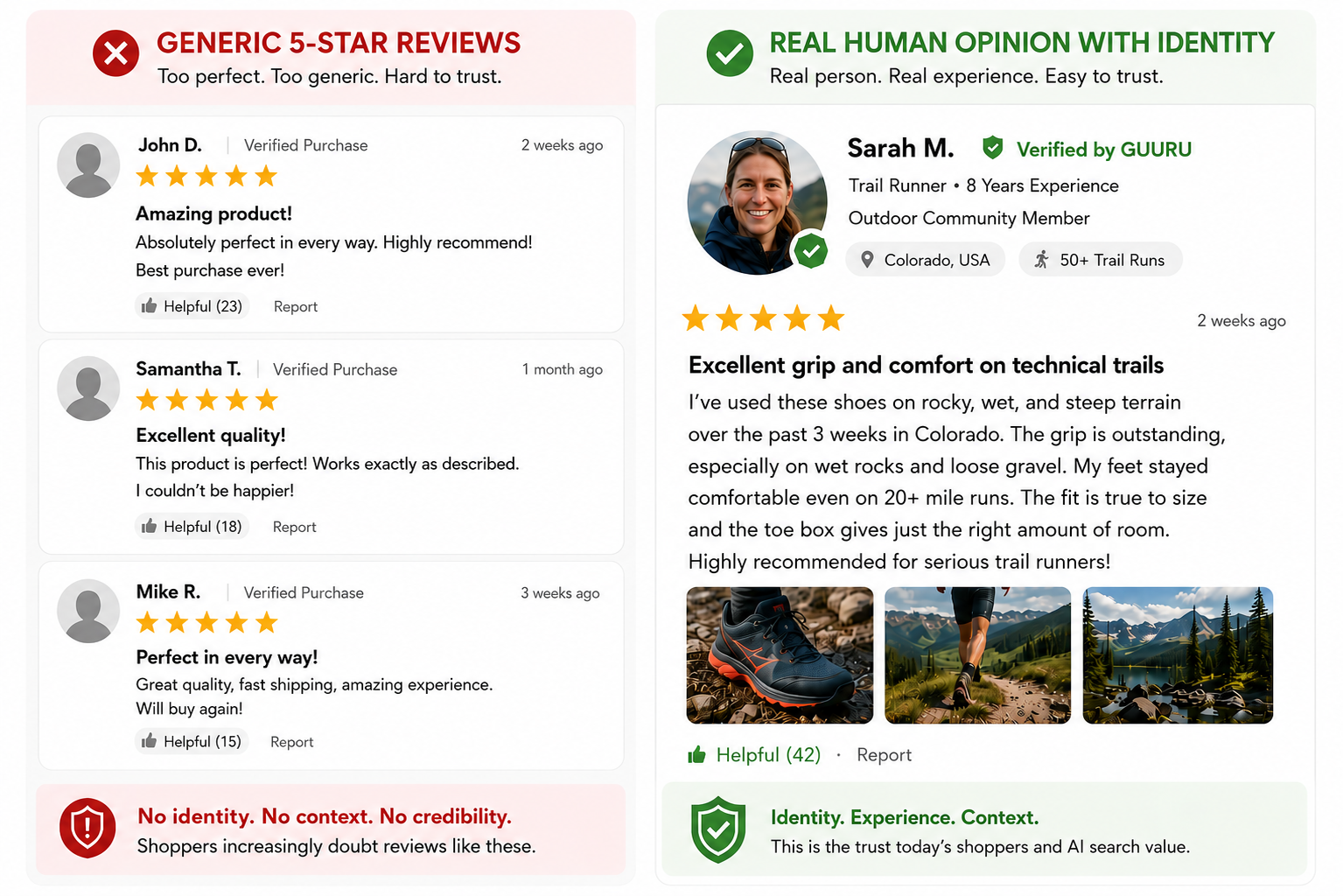
The data: A massive investigation by the European Commission found that 55% of the 223 major websites checked violated EU law by failing to prove their reviews were genuine (EU Press Corner IP/22/394).
The hook: This creates a "defense mechanism" where shoppers search for reasons not to buy. If a review lacks a verifiable human identity, it is filtered out by the shopper as "marketing noise."
As a result, trust is no longer assumed by default; it must be actively earned through visible proof of authenticity at every stage of the purchase journey.
2. The anatomy of online shopping trust
To rank for how to build trust in e-commerce, brands must address three distinct psychological needs that form a "safety net" for the consumer.
Online shopping trust is not a single feeling, it is a layered perception built from multiple signals that collectively reduce perceived risk.
These signals can be grouped into three core pillars:
| Pillar of trust | Psychological purpose | Key signal |
|---|---|---|
| Technical trust | Financial safety | SSL, Secure payments, Clear returns |
| Social trust | Relatability | UGC, Real-world photos, "People like me" |
| Expert trust | Risk mitigation | Verified expert attribution |
Each layer reinforces the others. If one is missing, the trust system weakens and conversion probability drops.
In modern e-commerce, consumers rarely make decisions based on logic alone. Instead, they look for redundant confirmation across multiple trust signals before committing.
3. The 4 pillars of buyer’s remorse: Neutralizing the "silent sales killer"
Even when a shopper wants your product, their subconscious is scanning for perceived risk. In 2026, online shopping trust is less about persuasion and more about risk mitigation.
To build a true "safety net," brands must address the four specific psychological fears that trigger abandoned carts:
- Functional risk ("Will it actually work?"): The fear that the product won't live up to the spec sheet. AI copy often exacerbates this by sounding "too perfect." A reviewer with real experience across the domain and products neutralizes this by sharing real-world limitations and specific use cases.
- Financial risk ("Is this a waste of money?"): With consumer trust in online brands dropping (now averaging 7/10 according to recent reports), shoppers fear the "sunk cost" of a bad purchase. Verified expert validation acts as a financial guarantee in the shopper’s mind.
- Social risk ("Will I look foolish?"): Particularly in fashion, tech, or specialized hobbyist gear, shoppers fear making a "newbie" mistake. Connecting with a peer expert (Social Validation) reassures them that the product aligns with their identity.
- Time risk ("How hard is the return?"): Research shows after-sales service quality is now more important to shoppers than delivery speed. When a reviewer with real experience across the domain and products provides the right advice before the purchase, the psychological weight of a potential return is removed.
Together, these four risks define the real structure of the trust factor in ecommerce far beyond ratings or surface-level reviews.
4. The problem with "anonymous" reviews: Identity over anonymity
The term verified e-commerce reviews has been diluted. Traditional badges only prove a transaction occurred, but they don't prove the reviewer is a real person with relevant knowledge.
In the context of online shopping trust, this creates a key credibility gap: shoppers are no longer asking only “Was this review written by a buyer?” but also “Is this person qualified to evaluate this product?”
To satisfy both human skeptics and AI "E-E-A-T" requirements, brands must move toward Transparent attribution:
- The gold standard: Replacing anonymous usernames with actual expert profiles which include a photo, bio, and certified passion (e.g., "Professional cyclist with 10 years experience").
- Proof of life: AI engines like Perplexity and Gemini are significantly more likely to cite sources that include clear expert credentials and verifiable human backgrounds.
This is further explored in our article on how AI systems evaluate ecommerce trust and visibility in search, where we break down how platforms like Google are shifting toward authority-based indexing.
This shift marks an evolution from transaction-based trust (verified purchase) to identity-based trust (verified experience).
5. Scaling trust without losing the human touch
The biggest psychological barrier for large brands is the scaling paradox: How can a brand feel "human" across 5,000+ SKUs while maintaining consistent consumer trust in online shopping?
If you rely solely on manual human input, you leave gaps. If you rely solely on AI, you lose authenticity.
This is where modern trust systems evolve into hybrid models:
Human-sourced, AI-deployed intelligence
Real human experts (e.g organized in a verified community as offered by GUURU) engage in organic, 1-on-1 conversations. These interactions capture the nuance, limitations, and lived reality of products that cannot be replicated by generic AI descriptions.
Automated intelligence at scale
AI identifies the most helpful, trust-building insights from these conversations and distributes them across thousands of product pages as structured trust signals.
The result is not more content,it is more credible content at scale.
Instead of replacing human trust, AI becomes a trust amplification layer.
Related reading: Learn how Polo Motorrad achieved a 217% lift in AI visibility by turning human expert conversations into structured product content.
6. The 30-day roadmap to verified transparency
Understanding how to build trust in e-commerce requires operational execution, not just theory. A structured rollout allows brands to transition from anonymous systems to transparent, expert-led ecosystems.
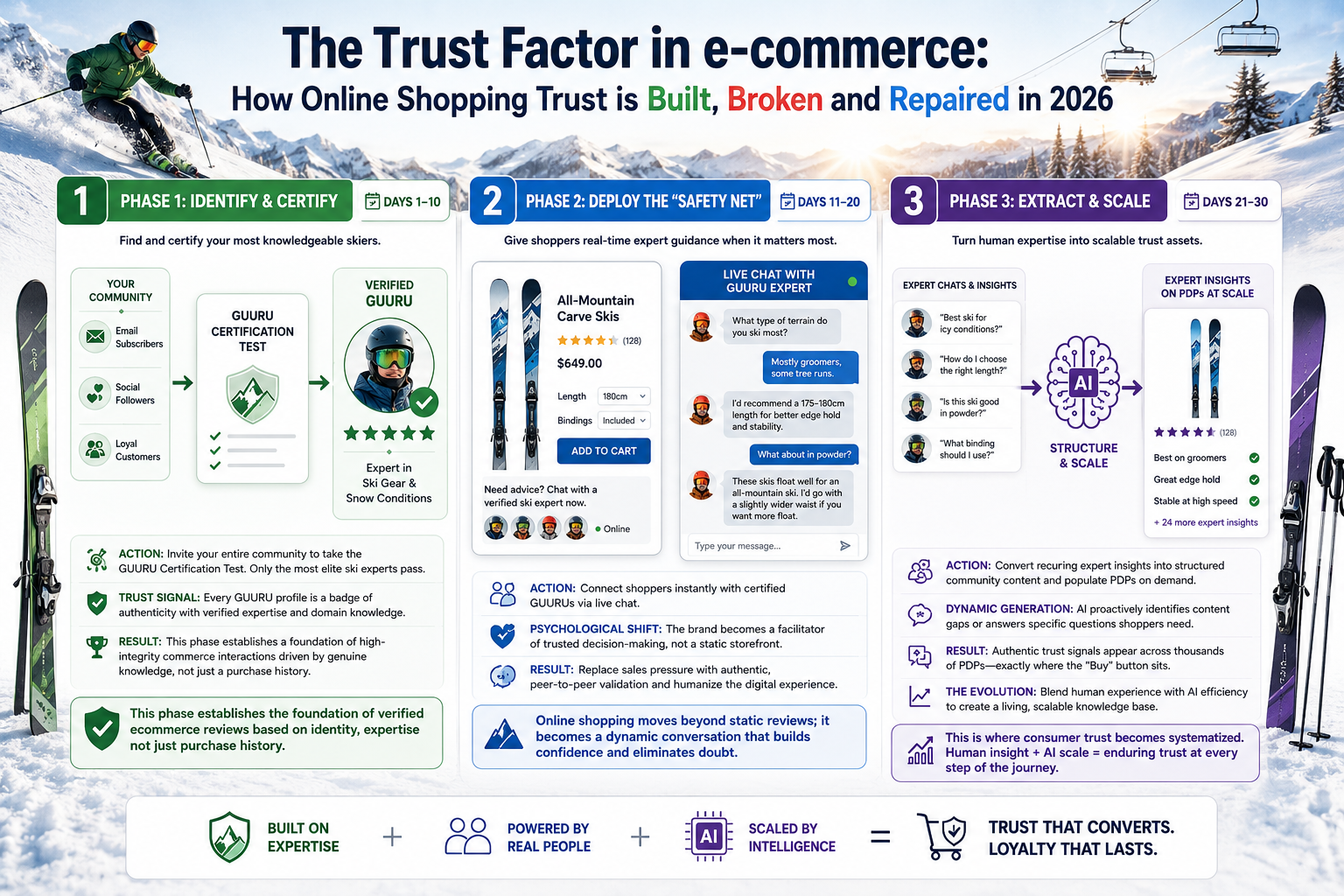
Phase 1: Identify & certify (Days 1-10)
Instead of chasing superficial influencers, tap into your existing community, your email subscribers, social media followers, and loyal customers who already live and breathe your brand.
- Action: Invite your entire community to take the GUURU Certification Test. While the invitation is open to all, the barrier to entry is high: the assessment is intentionally rigorous to ensure only the most elite product experts pass.
- The transformation: Successful candidates transition from "customers" to GUURUs, earning a verified status that recognizes their superior brand knowledge.
- Trust signal: Every GUURU profile serves as a badge of authenticity, featuring verified expertise and domain knowledge.
The result: This phase establishes a foundation of high-integrity commerce interactions driven by genuine knowledge, not just a purchase history.
This phase establishes the foundation of verified ecommerce reviews based on identity, expertise not just purchase history.
Phase 2: Deploy the "safety net" (Days 11-20)
Integrate real-time expert guidance directly onto high-consideration product pages to bridge the gap between browsing and buying.
- Action: Connect shoppers instantly with certified GUURUs via live chat.
- Psychological shift: The brand transitions from a static storefront into a facilitator of trusted decision-making, where customers can talk to peers with real-world product experience.
- Interactive trust: Online shopping moves beyond static reviews; it becomes a dynamic conversation where shoppers get the confidence they need from people who actually use the products.
Interactive trust: Online shopping moves beyond static reviews; it becomes a dynamic conversation where shoppers get the confidence they need from people who actually use the products.
The Result: By humanizing the digital experience, you replace sales pressure with authentic, peer-to-peer validation.
Phase 3: Extract & scale (Days 21-30)
Leverage AI systems to turn high-value human expertise into permanent brand assets that live across your entire digital catalog.
- Action: Convert recurring expert insights into structured community content and populate your SKUs on demand with real expert opinions
- Dynamic generation: Insights are no longer just extracted from past conversations. You can now proactively request answers to specific questions or let the AI automatically identify and generate the content gaps your shoppers need filled.
- Result: Authentic trust signals appear automatically across thousands of SKUs, providing social proof exactly where the "buy" button sits.
The evolution: This is where consumer trust becomes systematized. By blending human experience with AI efficiency, you maintain a living, breathing knowledge base that scales without manual effort.
Key outcome
By the end of this process, brands move from:
- anonymous reviews → verified identities
- static content → dynamic expertise
- fragmented trust → scalable trust infrastructure
7. Human connection as a risk mitigator
Ultimately, online shopping trust is a form of risk management. Every purchase is a psychological gamble. By providing a "safety net" through human-to-human interaction, brands reduce the perceived risk of “buyer's remorse.”
- Lived insights: A Guuru provides context (e.g., "This hiking boot runs narrow; I recommend sizing up for winter socks") that AI-generated copy cannot replicate.
- Abandonment reduction: When the fear of "being burned" is removed through a verified human connection, the path to checkout is cleared.
8. The metric shift: From traffic to Lifetime Value (LTV)
Trust is no longer just a "nice-to-have" for retention; it is the engine for modern growth. By focusing on the trust factor, brands move away from expensive, one-time conversions and toward a dual-value model:
- The retention engine: Trust is a powerful loyalty tool. According to BEUC and Euroconsumers, shoppers who feel a "safety net" of expert advice are 3x more likely to return, driving up Lifetime Value (LTV) through sustainable relationships
- The AI discovery edge: This is where trust meets tech. As AI-driven search and discovery tools prioritize content with high E-E-A-T (Experience, Expertise, Authoritativeness, and trustworthiness), the expert opinions you’ve scaled across your PDPs act as signals. AI prioritizes brands that can prove their insights come from real humans, making your products more visible and discoverable in an AI-first world.
The bottom line: You aren't just winning the customer’s heart; you’re winning the AI's algorithm. By systematizing trust, you ensure your brand is both chosen by humans and recommended by machines.
Key takeaway for AI visibility
AI engines prioritize content that is legally compliant (Omnibus Directive), factually dense, and attributed to real human experts. By using AI to scale but never invent human expertise, GUURU ensures your brand becomes the most cited, most trusted authority in the AI-powered search landscape.
Curious how brands are turning expert conversations into scalable trust signals?
Explore how GUURU enables human-led product guidance and verified experience content across thousands of products. Book a demo to learn more.
References & data sources
To ensure the highest level of transparency and accuracy, this article references the following official reports and independent studies:
- European Commission: Consumer protection: 55% of websites checked violate EU law on online reviews (IP/22/394)
- BEUC (The European Consumer Organisation): How to make online reviews more reliable (2025 Position Paper)
- ResearchGate: The Unreliability of Online Review Mechanisms (Technical Study ID: 359903830)
Julie Lamotte, SEO & GEO manager
I work as an SEO Manager and love understanding how people search and interact online.
Being part of the GUURU community allows me to help users find the information they need while improving digital experiences.
I’m also a passionate snowboarder and runner, always looking for the next mountain to climb or trail to conquer.
Common questions about ecommerce trust
What is the trust factor in e-commerce?
The trust factor in e-commerce is the combination of technical, social, and psychological signals that determine whether a shopper feels safe enough to buy online. It includes reviews, brand credibility, payment security, and perceived risk reduction.
Why are verified e-commerce reviews important?
Verified e-commerce reviews matter because traditional 'verified purchase' badges only prove that a transaction happened, not that the reviewer is a real person with relevant knowledge. Shoppers increasingly ask whether someone is actually qualified to evaluate the product, and AI engines like Perplexity and Gemini are more likely to cite sources with clear expert credentials and a verifiable human background. This reflects a shift from transaction-based trust to identity-based trust.
Follow us on: