


By Rafaela Ruf - Head of product at GUURU and UGC expert
Building Your Brand’s Presence in AI Search Starts with Deeper Topic Coverage
How community expertise helps brands answer more buying questions with useful, experience-based content.
When someone asks an AI assistant for help choosing a product, which brands come up? And do those same brands appear when the shopper asks a slightly different question? Recent research from Semrush suggests there is still considerable room for brands to build a more consistent presence. Its study with Kevin Indig examined more than 50,000 brands across 1,094 topics in ChatGPT. Only 15.2% of those topics had a brand with a clear, consistent lead under the study’s criteria.
For brands, this opens up an opportunity to own and dominate entire categories in AI search. Many topics still lack a clear leader, leaving room to establish your brand as a consistent recommendation and source of answer. Taking that opportunity requires useful content across the questions people ask as they explore a topic and work towards a decision. Much of the knowledge needed to create that content already exists among people who use the products. The challenge is bringing it onto the website at scale.
One question only tells you part of the story
Imagine your brand appears when someone asks ChatGPT to recommend a waterproof hiking jacket. That is a positive signal. But it tells you little about what happens when the shopper asks about jackets for warmer weather, wearing one with a heavy backpack, or choosing between two types of shell.
Semrush approached this by tracking five related prompts per topic, covering different stages of a buyer’s research. Its message is straightforward: assess visibility across a group of meaningful questions. The study also found that broad SEO metrics, including organic traffic and domain authority, did not reliably distinguish the leading brand from its closest competitor. Strong SEO remains valuable, but those metrics alone cannot explain a brand’s presence across a topic.
For content planning, this points towards a more detailed question: how well does your website cover the decisions, concerns, and situations within the subjects you want to be known for?
Useful coverage goes deeper than a product description
A product description can tell you that a jacket is waterproof. Someone who has worn it on a steep climb in warm rain can tell you how it feels. Both kinds of information help. As a shopper gets closer to a decision, practical details often become more important. Will the jacket fit comfortably over insulating layers? Does it restrict movement with a loaded backpack? Is it easy to pack away when the weather changes? A category page might explain which features to consider. A buying guide might compare different types of jacket. Product pages can then provide the detail someone needs to decide which option suits them. Together, these pages can cover a topic in a way that reflects how people actually shop.
Google’s documentation on its AI search features helps explain why this breadth is relevant. AI Overviews and AI Mode may issue several related searches across subtopics to develop a response. Useful information can therefore contribute to a wider question than the phrase a page was originally written around. The aim is to make important pages more helpful by answering the questions that belong there.
Real experience gives your content something more to say
Brands already have valuable information in their product data, technical expertise, and editorial content. Customers and domain experts can add another kind of knowledge: what happens when those products become part of everyday life. An experienced hiker may know how a jacket feels after several hours under backpack straps. A regular commuter may explain how easy it is to carry and put on quickly. Someone who has used it through a full season can describe what they have learned about care and durability. These perspectives give other shoppers something concrete to consider. They can also help make a page more distinctive by adding observations that are absent from the specification sheet. Google’s guidance on helpful content encourages original information and firsthand experience, including knowledge gained from actually using a product or service. The value comes from the detail. “Great jacket” tells a reader very little. An account of when it worked well, what the person used it for, and where it had limitations can help someone make a better choice.
The challenge is creating that depth across a catalogue
For one page, collecting a few useful experiences may seem manageable. Across hundreds or thousands of products, the work quickly grows. Each category brings different questions. Each product serves different needs. Seasonal changes and new releases introduce more situations to cover. Doing this manually would mean finding gaps, identifying people with relevant experience, asking questions, organizing their responses, and bringing the contributions onto the appropriate pages. Keeping that process going would place a substantial burden on a content team. This is the practical bottleneck. Brands need a reliable way to turn the knowledge within their community into content around their priorities.
How GUURU brings community expertise into your content strategy
GUURU Community Content provides a platform for making that process work at scale.
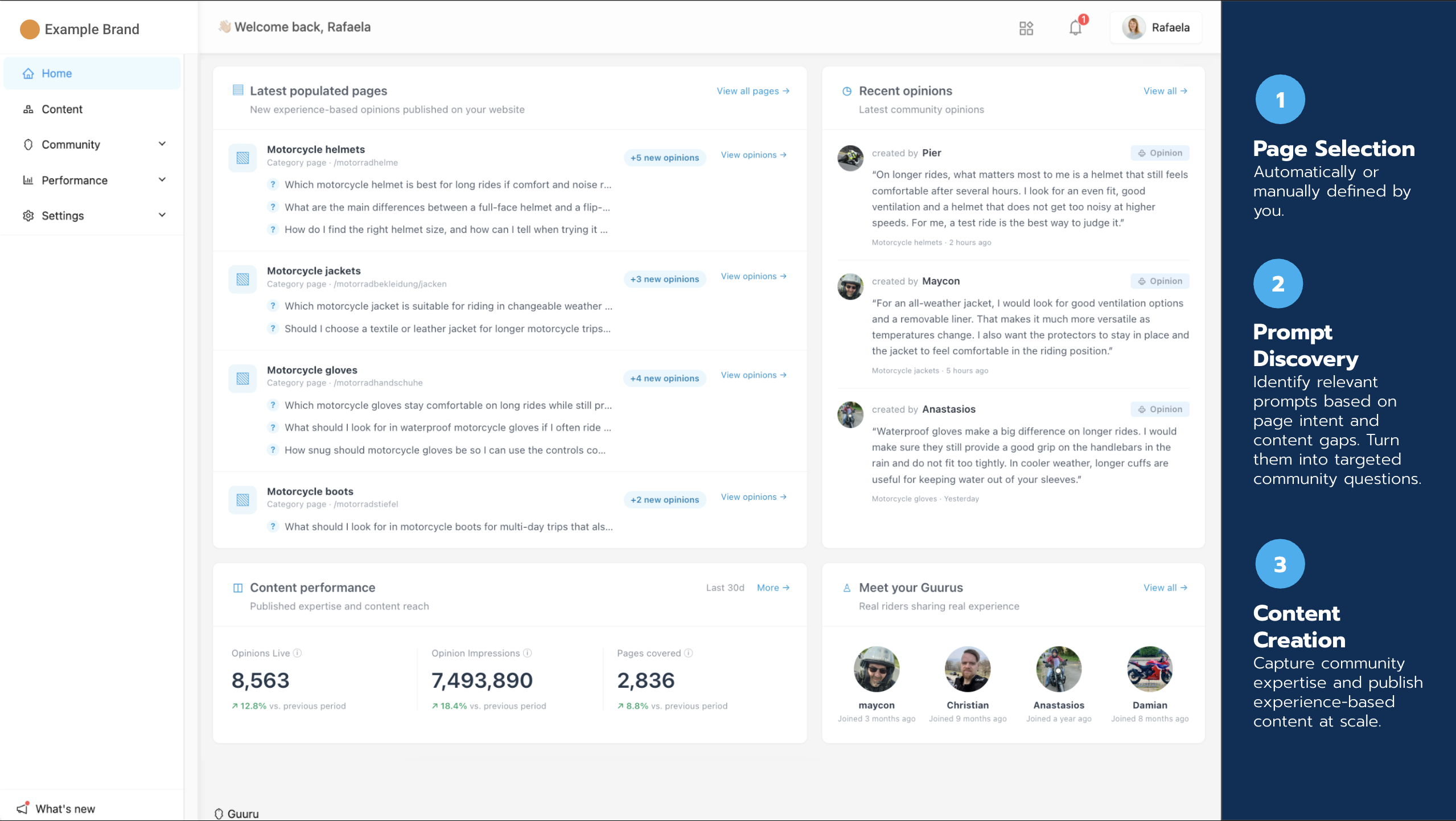
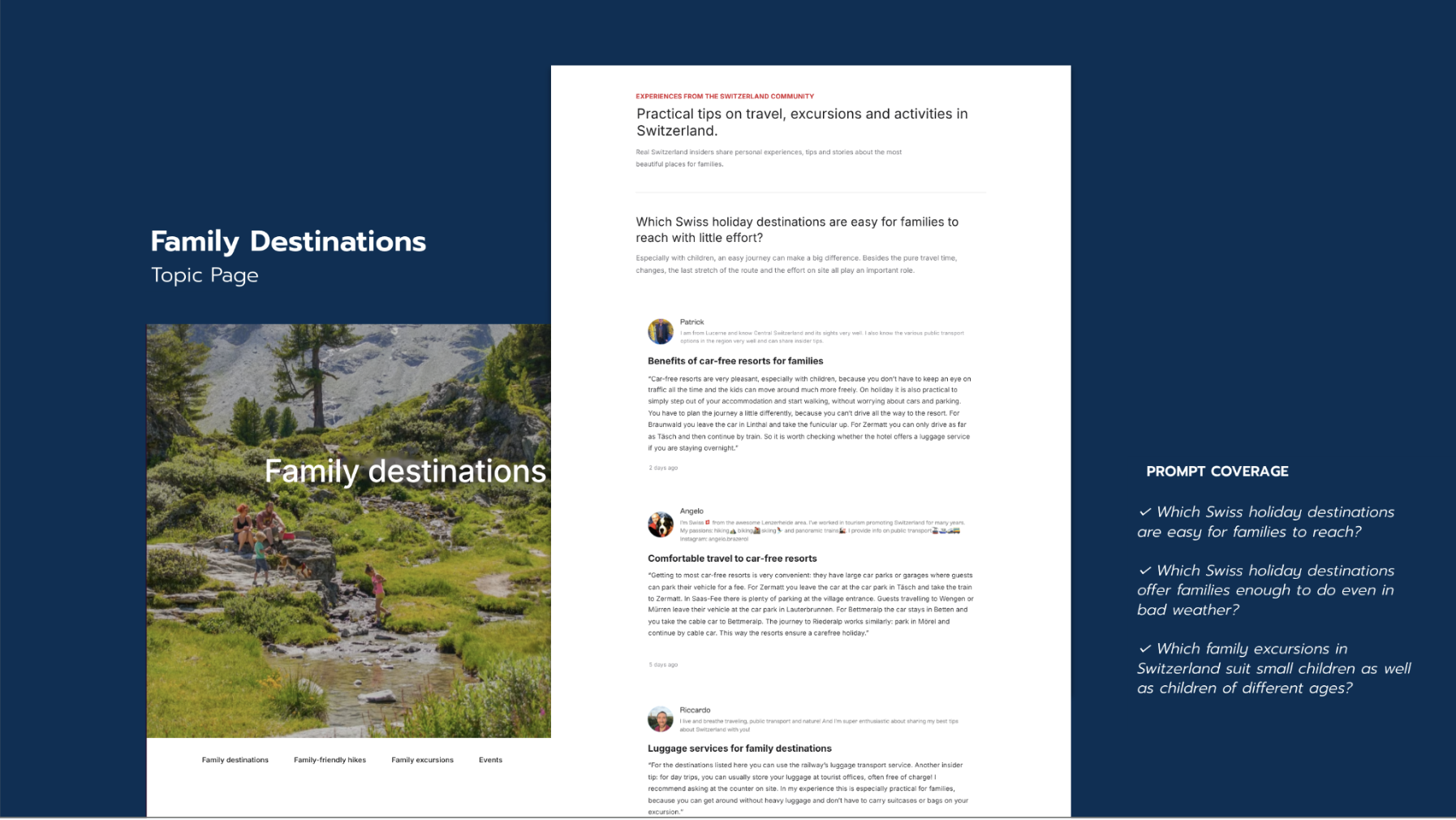
The brand chooses the pages, products, or topics it wants to strengthen. GUURU helps identify where useful customer insight is missing and proactively routes targeted questions to relevant community members. Their contributions add practical explanations, comparisons, opinions, and use cases. GUURU turns this knowledge into structured, crawlable content for product pages, category pages, landing pages, and editorial content.
For a content team, this creates a continuous way to develop coverage around its priorities, drawing on people who know the products through use.
From a missing answer to a relevant contribution
Consider an outdoor retailer developing its content around hiking in wet weather. Its pages already explain materials, waterproof ratings, and product features. What is missing is practical guidance about wearing the jackets in different conditions. Through GUURU, the retailer can generate targeted community contributions around those gaps. Questions might explore comfort during uphill movement, fit with a backpack, or choosing a jacket for a short walk versus a longer trip. These are examples of the kinds of questions that can bring useful experience into the content. The answers come from community members with relevant knowledge and can enrich the pages where that guidance belongs. A product page gains detail about fit. A category page gains perspective on different uses. A buying guide gains practical insight into the trade-offs shoppers are weighing.
The internal team sets the direction. The platform provides the process for bringing community knowledge into the content across those pages.
Build coverage you can keep developing
The value of this approach extends beyond an individual contribution.
As brands develop their content, community expertise can help them address more of the questions within a topic. That gives shoppers a fuller picture and creates useful material for search engines and AI systems to discover and potentially reference. Progress should be assessed across related questions over time. A brand mention, a page citation, and a website visit each tell a different part of the story. Engagement with the content and changes in purchasing behaviour can help show whether it is useful to customers too.
The Semrush study suggests to take topic coverage seriously - and highlights that there is big opportunities for brands to build topic coverage. It is a perfect time to proof how stronger content contributes to a brand’s presence.
Turn customer knowledge into a lasting content capability
Your customers and brand community know things about your products that a specification sheet cannot explain. Those details can help answer the practical questions people ask as they explore, compare, and choose. Building useful coverage around those questions takes both a clear strategy and a process that can grow with the business. GUURU brings those pieces together, helping brands turn community expertise into relevant content across the topics that matter to their customers.
Explore how GUURU Community Content can help strengthen your priority pages
Rafaela Ruf, Head of product
With 15 years of experience in product management, Rafaela loves being the connecting piece between what users want and what technology can build. Joining GUURU in 2020, Rafaela enjoys lean experimenting and the hands-on work at a startup. She is also a passionate dancer and member of Lisbon’s Forró dance community. Follow Rafaela on LinkedIn.
Follow us on: