

By Urban Kopitar - Sales Enablement & Marketing Specialist
Mount AI: why synthetic content is not a long-term AI visibility strategy
Key takeaways from this article
- AI-generated content is not the problem. Low-value, generic content is.
- The “Mount AI” problem shows how mass-published synthetic content can create a fast visibility spike, followed by a sharp decline once Google reassesses quality, originality, and usefulness.
- This pattern has already appeared in several cases: Peec AI found Mount AI-style visibility drops across AI content success stories, SE Ranking’s 2,000 AI-article experiment collapsed after an early growth phase, and Ahrefs documented how the Causal “SEO heist” went from nearly 490,000 organic visits to traffic close to zero.
- Google’s issue is not with AI assistance but with content created primarily to boost rankings rather than help users.
- For e-Commerce brands, the stronger long-term strategy is not more synthetic content at scale. It is authentic expertise at scale, built from real product knowledge, customer context, and first-hand experience.
Why e-Commerce brands need real human expertise, not just more AI-generated pages
AI has made content production faster than ever.
In theory, that sounds like a dream for e-Commerce brands. More category pages. More product guides. More comparison articles. More answers to long-tail questions. More pages built for SEO, AIO, GEO, and every other acronym that now sits somewhere between marketing strategy and existential panic.
But there is a problem.
When everyone can generate more content, content volume is no longer a competitive advantage. In many cases, it becomes a liability.
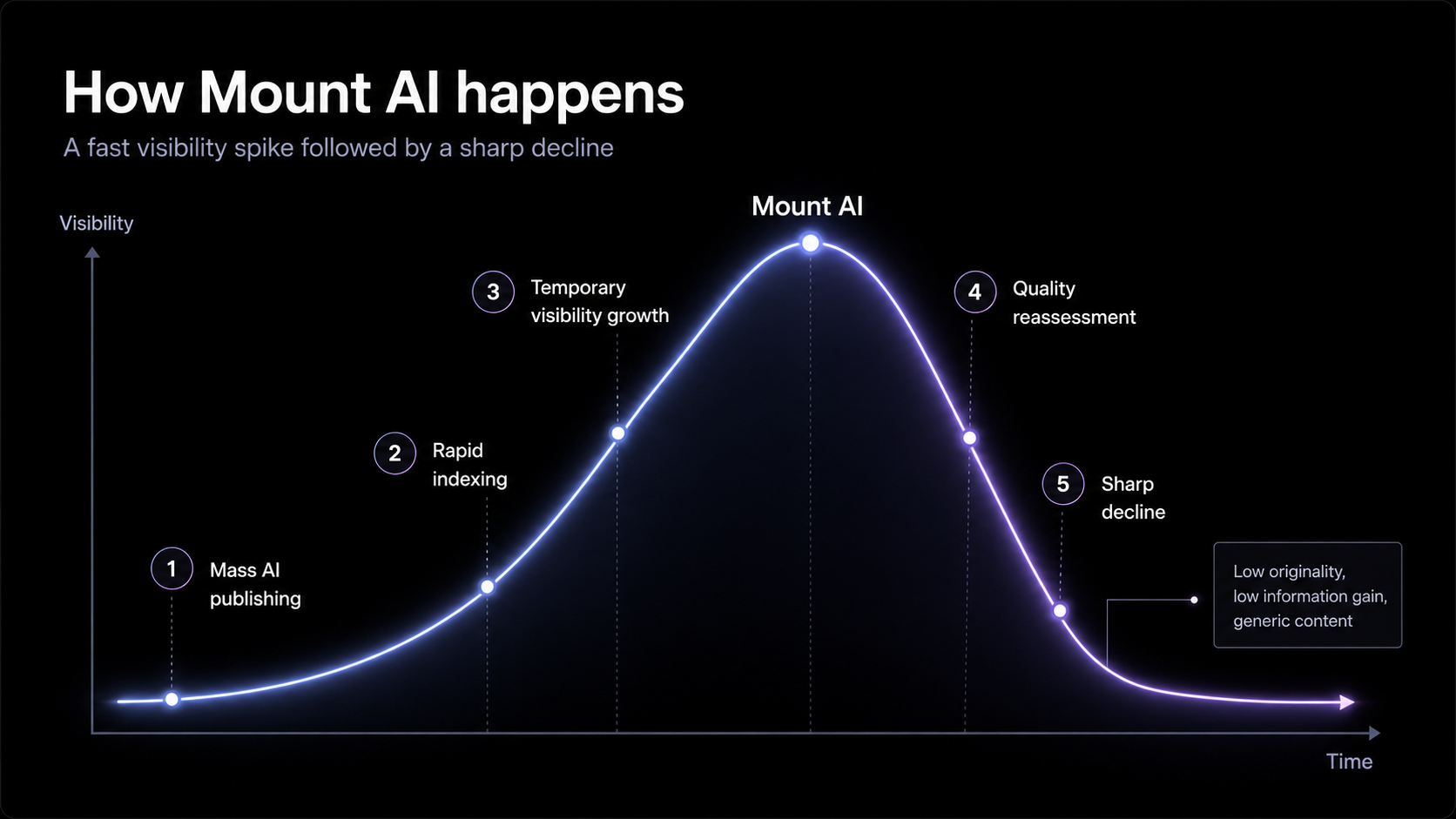
We are now seeing the early signs of what happens when brands treat AI-generated content as a shortcut to visibility. This pattern is increasingly described as Mount AI: a fast climb in rankings and impressions, followed by a sharp decline once quality signals catch up. Pages get published quickly. Rankings may climb. Dashboards may look promising for a while. Then, once the summit is reached, the decline starts.
The lesson is not that AI is useless. Far from it. AI can help structure, summarize, extract, and scale content workflows. The real issue is when synthetic content replaces the one thing that actually creates trust: real human experience.
For e-Commerce brands, this distinction is becoming critical. AI search systems, shoppers, and search engines are all moving in the same direction. They need content that is helpful, specific, trustworthy, and grounded in first-hand expertise. Generic AI copy does not meet that standard for long, and before you know it, Google starts de-indexing your pages.
What is Mount AI?
Mount AI describes a growing pattern across websites that publish large amounts of AI-generated content.
At first, the strategy can look successful. Pages get published quickly. Google indexes them. Impressions rise. Traffic charts move in the right direction.
Then the re-evaluation comes.
SEOs have started calling this pattern “Mount AI”: a steep visibility climb created by mass-published AI content, followed by an equally steep drop once search engines reassess the quality, originality, and usefulness of the content. In simple terms, Mount AI is what happens when content volume creates temporary visibility before weak originality and low information gain pull performance back down.
Mount AI is no longer just a theoretical risk
This is not just a theory. Here are multiple sources showcasing this occurrence.
Peec AI recently called this pattern the “Mount AI” trap. Their analysis looked at companies using AI content generation as part of their search strategy and found cases where visibility grew quickly before dropping sharply. In one analysis, Peec reported that 36% of brands featured in one AI content tool’s success stories showed this type of surge-and-collapse trend in Google visibility. Their core point was clear: using AI as a writing assistant is usually fine, but publishing raw AI output at scale without adding real value can backfire. (Peec AI, 2026)
SE Ranking found a similar pattern in a controlled experiment. They published 2,000 AI-generated articles across 20 brand-new domains and tracked them for 16 months. In the first month, 71% of pages were indexed and the sites generated 122,000 impressions. During months two and three, impressions grew further. But between months three and six, rankings collapsed, with only 3% of pages remaining in the top 100, down from 28%. After 16 months, there was no meaningful recovery. (SE Ranking, 2026)
The Causal “SEO heist” is another well-known example. According to Ahrefs, the company published 1,800 AI-generated articles based on a competitor’s sitemap and reached almost 490,000 organic visits in one month. Soon after, traffic dropped close to zero. In a later Ahrefs analysis of SaaS traffic losers, Causal’s estimated organic traffic was down 99.52% year over year. (Ahrefs, 2024)
There are many case studies like these that all show a similar sequence of events.
That is the danger of synthetic content as a growth strategy. It can create the appearance of momentum before the underlying quality signals catch up.
And once visibility drops in Google, the damage may not stop with traditional search. Many AI search experiences rely on search indexes, citations, and web signals to ground their answers. If a brand loses organic visibility, it will also become less visible in AI-generated answers.
Does AI-generated content hurt SEO and AI visibility?
Google is not against AI content. It is against low-value content
A common misunderstanding is that Google “penalizes AI content.” That is not the most accurate way to frame it.
Google’s own guidance says generative AI can be useful for researching topics and adding structure to original content. The problem begins when brands use generative AI to create many pages without adding value for users, which may violate Google’s scaled content abuse policy.
Google's scaled content abuse policy, introduced in March 2024, targets the practice of generating many pages for the primary purpose of manipulating Search rankings rather than helping users.
Google’s people-first content guidance is even more explicit. It asks whether the content provides original information, reporting, research, or analysis.
It asks whether the content demonstrates first-hand expertise and depth of knowledge, for example, expertise that comes from actually using a product or service. It also encourages clear authorship, evidence of expertise, and transparency around how content was created.
This is where many AI content strategies fail.
They create pages that look like content, but do not provide much, or in some cases, even any information gain. They summarize what already exists. They repeat obvious points. They use generic wording. They answer questions without showing real evidence, context, use cases, or experience.
In other words, they produce text, but without trust or value.
That difference is becoming more important as search and AI systems become better at identifying content that is unoriginal, thin, or created primarily to capture rankings.
How to avoid the Mount AI trap: real opinions on product pages
The interesting part is that the opposite pattern also exists.
If synthetic content is fragile because it repeats what already exists, real human opinions can create the kind of information gain that search engines and AI systems are looking for.
Instead of adding another generic paragraph to a product page, brands can add specific answers from people who actually know the product, the use case, and the buyer’s doubts.
Real product insights create measurable AI visibility gains
We have seen this directly in our own client work.
In one recent e-Commerce case, more than 2,500 unique community opinions were published across 1,800 product pages in six months.
These were not generic AI-generated descriptions. They were short, product-specific insights written by experienced community members and embedded directly on the PDPs.
After implementation, domain visibility in Google AI Mode and AI Overviews increased by 217%, while product page citations in AI-generated answers increased 5×. The measurement was based on 100 real-world, unbranded, high-intent prompts, tracked before and after implementation.
In another test, real community opinions were added to selected product pages and measured across Google AI Overviews and Perplexity.
The result was a 51% increase in domain visibility and a 59% increase in product pages appearing as sources in AI-generated answers.
Again, the key was not content volume alone. The uplift came from adding human-authored, product-specific answers that were crawlable, indexable, and placed directly where purchase decisions happen.
You can check out our case studies here.
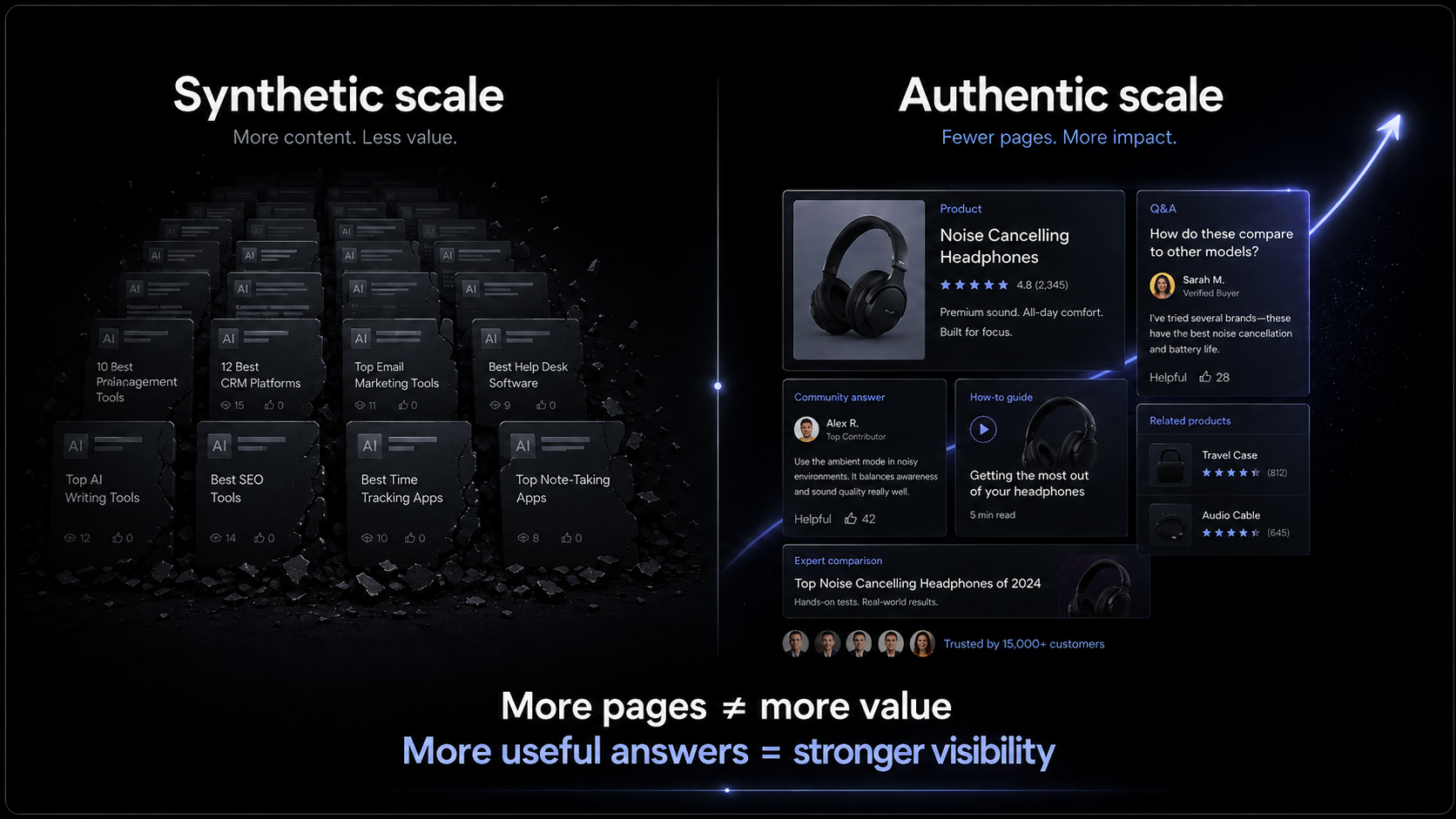
This is the difference between scaling synthetically or authentically.
A synthetic scale creates more pages.
An authentic scale creates more useful answers.
For e-Commerce brands, that distinction matters. AI systems do not need another generic product summary. They need clear, specific, trustworthy information that helps answer real buyer questions.
When that information comes from people with first-hand experience, it gives both shoppers and AI systems something more valuable to work with.
That is why real human opinions are not just a trust asset. They are also an AI visibility asset.
The test: Does this content add knowledge or experience?
For brands, the practical question after seeing the Mount AI pattern is not “Was this written with AI?”
The better question is: Does this content add real knowledge or first-hand experience that shoppers could not easily find elsewhere?
A generic AI-generated product paragraph usually summarizes visible facts: features, specifications, benefits, and category-level advice. That may be accurate, but it rarely adds much information gain.
Knowledge and experience-based content works differently.
It explains when a product is the right fit, when it is not, what buyers often misunderstand, which details matter in practice, and how the product compares to alternatives in real situations.
For e-Commerce teams, this creates a simple quality test:
- Does the page include a real use case?
- Does it mention a meaningful trade-off?
- Does it help a shopper make a decision?
- Does it make the reader learn something new?
- Could the same points appear on ten competitor pages?
If the answer is no for the first 4 points and yes to the last one, you probably need to adjust the page you’re about to publish.
For AI visibility, that distinction matters. AI answer systems do not need more generic copy. They need sources that answer specific questions with clarity, context, and confidence.
The best content for long-term performance, both in SEO and GEO, is therefore not just optimized. It is informed by real knowledge, experience, and research.
Conclusion: Authentic expertise scales better than synthetic content
AI has made content easier to produce, but that does not automatically make the content useful.
The “Mount AI” problem shows what can happen when brands rely on synthetic content as a shortcut to visibility. It may create momentum for a while, but without original knowledge, real experience, or practical value, that visibility becomes fragile.
For e-Commerce brands, the better path is not to avoid AI. It is to use AI in the right role.
AI can help structure, summarize, and scale content workflows. But the expertise itself should come from real people: customers, community members, product users, and experts who understand the product and the buyer’s context.
That is the content search engines can trust, AI systems can cite, and shoppers can actually use.
In the long run, the brands that win in AI visibility will not be the ones publishing the most content. They will be the ones making their real expertise easier to find, understand, and trust.
Urban Kopitar, Marketing & Sales enablement specialist
As a marketing & sales enablement specialist, Urban helps translate GUURU’s solution into clear, compelling stories that show the real value it creates for e-commerce brands. Since joining GUURU in 2024, Urban has focused on enabling sales and marketing campaigns that highlight how GUURU helps clients build trust, answer shopper questions, and create content that boosts AI visibility and drives conversion. Follow Urban on LinkedIn.
Common questions about Mount AI and synthetic content
What is Mount AI?
Mount AI is the name SEOs use for a pattern where mass-published AI-generated content produces a fast climb in rankings and impressions, followed by a sharp decline once search engines reassess quality, originality, and usefulness. The spike looks like momentum, but weak originality and low information gain pull performance back down. In one controlled SE Ranking test, only 3% of 2,000 AI articles remained in the top 100 after an early surge.
Does Google penalize AI-generated content?
No. Google's own guidance says generative AI can help research topics and add structure to original content. What Google targets is its scaled content abuse policy, introduced in March 2024, which covers pages created mainly to manipulate rankings rather than help users. The issue is low-value, unoriginal content at scale, not the use of AI itself.
How can ecommerce brands avoid the Mount AI trap?
Replace synthetic scale with authentic scale: instead of publishing more generic pages, add specific answers from people who actually know the product, the use case, and the buyer's doubts. This first-hand, product-specific content creates the information gain that search engines and AI systems reward, which keeps visibility durable rather than fragile. In one case, more than 2,500 community opinions across 1,800 product pages lifted domain visibility in Google AI Mode and AI Overviews by 217%.
Why does losing organic search visibility also reduce a brand's visibility in AI answers?
Many AI search experiences ground their answers in search indexes, citations, and web signals. When a brand's organic visibility drops in Google, those same signals weaken, so the brand also becomes less likely to appear in AI-generated answers. A Mount AI collapse can therefore cost a brand visibility in both traditional search and AI search at once.
Follow us on: