


By Urban Kopitar - Sales Enablement & Marketing Specialist
Which UGC Platform Is Best for AI Search Visibility?
No single UGC platform wins AI search visibility everywhere. For ecommerce brands, actively participating in relevant conversations on Reddit and YouTube is one part of an off-site GEO strategy. Your own website can also be a home for authentic user-generated content, with greater control over where and how it appears.
Choose a solution that brings verified customer expertise onto your product and category pages as attributed answers that AI engines can crawl and cite, and complement it with genuine participation where your customers already discuss your products.
The choice matters because AI answers now shape a growing share of product research. Adobe data reported by Digital Commerce 360 shows AI-referred traffic to US retail sites grew 62% year over year in July 2026, and those visits converted 60% better than non-AI traffic.
This guide covers what counts as a user-generated content (UGC) platform, which ones AI engines cite most, and how to choose.
What counts as a UGC platform in AI search?
AI answers to this question draw on two readings: community platforms where people post on their own, like Reddit and YouTube, and software brands use to publish customer content. The first two things that matter in differentiating UGC platforms for your brand are where the content lives, and how much of it you control.
| Type | Examples | Where the content lives | Your control | Role in AI search |
|---|---|---|---|---|
| Community and social platforms | Reddit, YouTube, Facebook, LinkedIn, Quora | Third-party sites | Low (earned) | The most-cited UGC sources; each engine has its favorites |
| Review sites | Trustpilot, Yelp, G2 | Third-party sites | Medium (invite, respond) | Inputs for review summaries and comparisons |
| On-site review and Q&A software | Bazaarvoice, Yotpo, Okendo | Your site, sometimes retail partners | High | Counts only if AI crawlers can read it |
| On-site community expertise | GUURU, which turns verified customer expertise into AI-visible content | Anywhere on your website | High | Expert answers to buying questions on pages you own |
| Creator marketplaces | Billo, Insense | Ads and social channels | Medium (commissioned) | Indirect; depends on where the videos are published |
For a vendor-by-vendor comparison, see our guide to the best UGC platforms for ecommerce.
Which UGC platforms does AI search cite most in 2026?
YouTube and Reddit are the UGC sources AI search cites most; which one leads depends on the engine.
Google's AI surfaces lean on YouTube.Ahrefs' UGC AI Visibility Trends benchmark, updated 2 November 2026, found YouTube referenced in 48.8% of the 8.8 million Google AI Overviews responses it tracked on 1 November. Facebook (20.9%), Instagram (15.7%) and Reddit (11.7%) followed, while Quora, LinkedIn and Trustpilot each appeared in fewer than 3%.
The chatbots lean on Reddit.Searchable analyzed 3.2 million source pages from five engines between 12 and 25 October 2026: Reddit made up 90% of ChatGPT's user-generated sources and 82% of Gemini's. Peec AI's March 2026 analysis of 30 million US sources also ranked Reddit first or second on every engine tested.
Where AI engines find their UGC (Searchable, 12 to 25 October 2026)
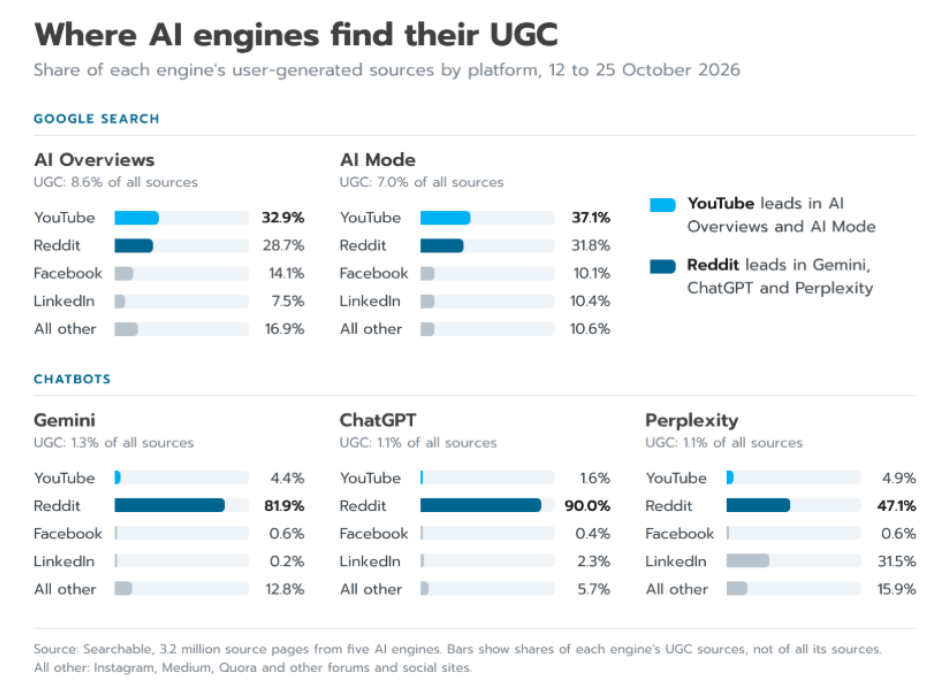
Google's AI surfaces use far more UGC than the chatbots, and Tinuiti's Q3 2026 AI Citation Trends Report notes that Google increasingly cites its own properties, such as YouTube, particularly in AI Mode. Category matters too: in the same report, social media accounted for 14% of AI citations for apparel prompts.
Why do studies disagree about UGC in AI search?
Because they define and count UGC differently. Depending on what counts as UGC, which queries were tested and what was measured, headline figures range from nearly half of all citations to low single digits.
- Broad definitions, high shares.AirOps analyzed 5.5 million AI answers in 2025 and found that UGC and community platforms drive nearly half of all citations, counting Wikipedia, GitHub, G2 and Trustpilot among them. Meltwater reports 47.5% for LinkedIn, Reddit, and YouTube from a LinkedIn-focused dataset.
- Narrow definitions, low shares. Searchable counted only forum and social pages and found UGC at 1% to 9% of sources, depending on the engine.
- Different query sets.Yext's analysis of 6.8 million citations, which included location-based queries, found that brand websites (44%) and listings (42%) supplied most citations, with reviews and social at 8%. In retail, first-party websites earned 47.6%.
Shares also swing fast. Tinuiti data reported by MediaPost shows Reddit's share of Perplexity citations falling from 25% in February 2026 to 7% in April. In August, Promptwatch saw Reddit's share of ChatGPT citations drop from 3.8% to about 0.5% within a week, a result it called provisional, according to Semrush; OpenAI said ChatGPT still cites Reddit.
Tinuiti's Jen Cornwell put it plainly in Search Engine Land: there is no universal top source. She recommends treating aggregate studies as hypotheses to validate with your own category data.
What makes user-generated content citable by AI?
Relevance, expertise, and first-hand detail count for more than popularity.
Semrush's study of 248,000 Reddit URLs cited in AI answers found that 80% of cited posts had fewer than 20 upvotes. Q&A threads made up more than half of Reddit citations, and Semrush concludes that AI tools select Reddit content by topical relevance.
Google's guide to generative AI features in Search, updated 10 July 2026, points the same way: distinctive, useful content is likely to matter more over time than any of its other suggestions. It contrasts a first-hand review, which offers a unique perspective, with a summary that restates what already exists, and it warns against commodity content and against recycling material a generative AI model could easily produce.
Reviews also feed product answers directly. OpenAI's help center says ChatGPT's shopping results use structured metadata from first-party and third-party providers, and that review summaries are generated from reviews on public websites, which OpenAI does not verify.
Can AI engines read & cite the UGC on your own site?
We have seen it time and time again with our clients. UGC on your own site, like community content, can be read by AI engines and increases both citations and mentions significantly for the topic of your choosing. You can check the numbers and methodology we used for this claim in our case studies backed by 3rd-party data from Peec & Profound.
However, there are some requirements. The UGC is in the HTML they fetch. Google can process JavaScript as long as it isn't blocked; other AI crawlers may not run it at all.
In a December 2024 analysis of crawler traffic on Vercel's network, Vercel and MERJ found that none of the major AI crawlers rendered JavaScript, including those from OpenAI, Anthropic and Perplexity. Gemini uses Googlebot's infrastructure and can render. Reviews or answers injected by a client-side widget may therefore be invisible to ChatGPT, Claude and Perplexity.
Vendors are responding. In September 2026, Bazaarvoice launched an AI Visibility Package that serves reviews in formats AI crawlers can read, and its CMO described standard JavaScript rendering as a "massive blind spot for AI crawlers," IT Brief reported. At GUURU we offer an API integration to inject Community Content directly into your HTML for all AI engines to read.
How to choose a UGC platform for AI search visibility
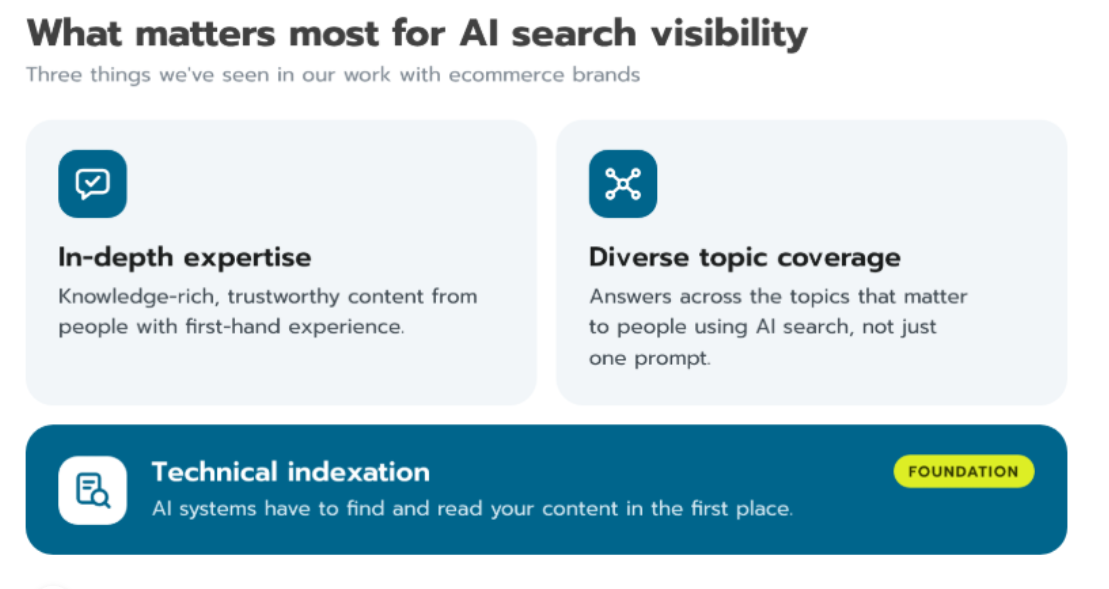
In our work with ecommerce brands, we've seen three things matter most for AI search visibility: in-depth expertise (content that is rich in knowledge and trustworthy), diverse coverage of the topics that matter to people using AI search in your industry, and proper technical indexation, so AI systems can find the content in the first place. Judge any UGC platform on all three, not on its feature list.
In-depth expertise
- Attributed, first-hand contributions. Named contributors with verified product experience match Google's emphasis on first-hand perspective.
- Information your product copy lacks. Trade-offs and real use cases add something new. Repeated spec text is the commodity content Google warns about.
Diverse topic coverage
- Answers to real buying questions. Q&A threads earn more than half of Reddit's AI citations in Semrush's data. Answers on fit, compatibility and use cases mirror that format.
- Depth across a topic, not one prompt. A July 2026 Semrush study with Kevin Indig tracked five related prompts for each of 1,094 categories in ChatGPT. Only 15.2% had a clear owner, a brand mentioned across most prompts with a clear lead. Its takeaway: "Winning one prompt in ChatGPT is not the same as owning a topic." We've written more about deeper topic coverage.
- Coverage that keeps pace with your catalog. New products & categories launch with no answers; ask how a platform fills gaps on new and long-tail pages.
Technical indexation
- Crawlable HTML on your domain. If you want to influence more than just AI overviews and AI mode from Google, you need to inject the content into your HTML.
- Indexed, snippet-eligible pages. To qualify for its AI features, a page must be "indexed and eligible to be shown in Google Search with a snippet," Google says, and even then indexing and serving aren't guaranteed.
Then measure. Track a fixed prompt set before and after launch, and note which of your URLs engines retrieve and cite. This way you can get a data-driven conclusion if a UGC provider or effort brought you AI search visibility.
Should you invest in Reddit and YouTube or in your own pages?
Both, for different reasons. Community platforms supply much of the user-generated evidence AI answers use today; your own pages are the one surface you control when those shares move.
Our view: earn your place on community platforms, and own the answers on your product and category pages. If the answer shoppers find about your product lives only in a Reddit thread, a shift like August's reported drop in ChatGPT's Reddit citations is outside your control. Verified customer answers on your own pages stay yours, and you can measure them page by page.
Give AI engines answers worth citing
When product and category pages leave buying questions unanswered, AI engines find answers elsewhere, often in Reddit threads and videos. GUURU Community Content turns verified customer expertise into crawlable answers across your product pages.
Book a demo to see what this could look like on your catalog.
Frequently asked questions
Can AI crawlers read reviews loaded with JavaScript?
Google AI Overview and AI mode can, as long as the content isn't blocked. A December 2024 Vercel and MERJ analysis found that major AI crawlers from OpenAI, Anthropic, and Perplexity did not render JavaScript, so ask vendors whether their content appears in the page's initial HTML.
Should brands post on Reddit to get cited in AI answers?
Only as genuine participants. Google says chasing inauthentic mentions isn't as helpful as it might seem, and Semrush advises contributing to discussions rather than marketing. Marketing threads on Reddit get deleted and your account banned quickly. Reddit's citation share also swings quickly, so pair it with content you own.
How can I measure whether my UGC gets cited in AI search?
Track a fixed set of buyer prompts in an AI visibility tool and record which of your URLs engines retrieve and cite, before and after new content goes live. For Google, add Search Console's Generative AI performance report.
Follow us on: