

By Urban Kopitar - Sales Enablement & Marketing Specialist
Google’s UCP is a wake-up call: AI search visibility will decide which brands get discovered
In this article, we cover:
- What is UCP, and how does it work?
- How is AI-Powered Commerce impacting e-commerce brands, and why is it ever more important to be visible in AI Search?
- What is our first take on UCP?
- How should e-commerce brands adapt to AI-powered commerce?
Introduction
The landscape of shopping is undergoing a fundamental shift as large language models increasingly help consumers discover, compare, and decide what to buy.
The biggest recent news in this area is Google's introduction of the Universal Commerce Protocol (UCP). Launched in January 2026, UCP aims to let shoppers go from a query to a purchase in one fluid AI-driven experience.
Notably, Google isn’t alone here. OpenAI and Stripe recently co-developed a similar AI-Powered Commerce Protocol for ChatGPT to enable instant purchases in chat. This marks the beginning of a broader shift toward AI-driven commerce, a trend no brand can afford to ignore.
What Is UCP and How Does It Work?
Google’s Universal Commerce Protocol (UCP) is essentially a new open-source standard for e-commerce in the AI era. Think of it as a universal “language” that lets shopping assistants and websites talk to each other directly, so an AI (like Google’s) can help a customer find a product and buy it on the spot.
By establishing common commerce functions and data formats, UCP enables AI-Powered commerce. This means AI agents can handle everything from product discovery and comparison to checkout and order tracking, without custom integrations for each retailer.
In other words, instead of every online store building one-off integrations or bots, UCP provides one standardized interface that any AI shopping assistant can use to interact with any participating brand’s store.
When the user decides to buy an item shown in an AI result, UCP facilitates a secure, instant transaction right within the conversation. Google’s system can tap into saved payment credentials (e.g., Google Pay or a linked PayPal account) to process the order on the merchant’s behalf.
Crucially, UCP is built in collaboration with the industry, not just Google alone. It was co-developed with e-commerce leaders like Shopify, Etsy, Wayfair, Target, and Walmart, and it’s endorsed by dozens of major companies from payment providers (e.g., PayPal, Visa, Mastercard) to retailers and tech firms.
How is AI-Powered Commerce impacting e-commerce brands, and why is it ever more important to be visible in AI Search?
Once widely adopted, UCP and the technology that follows it have the potential to reshape the entire e-commerce experience. The entire customer journey, from product discovery, decision-making regarding product purchases, and price comparisons for the specific products to the final purchase, will eventually be efficiently done within the LLMs.
E-commerce brands need to adapt quickly. Shifts in how shoppers discover products will change the traffic retailers and brands receive, with a direct effect on online store revenue and company profitability.
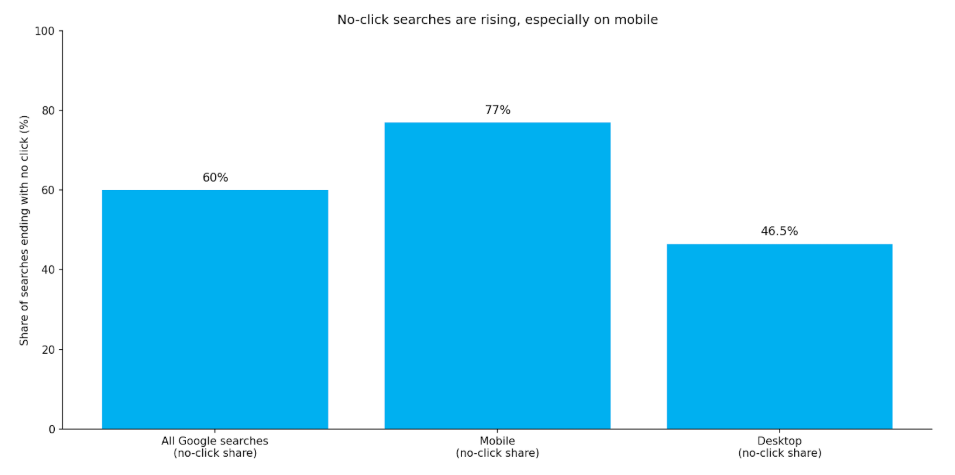
Recent data shows that already about 60% of Google searches end without any click to an external website. Mobile searches are driving this transformation: on phones, 77% of queries end without visiting another website, compared to 46.5% on desktop.
Early tests of Google’s AI Search Generative Experience (SGE) led to 18 - 64% declines in organic clicks from certain queries. Some websites have already reported traffic declines of over 70% when Google started showing rich AI answers, now known as AI overviews.
For e-commerce, this means a customer might get all the info they need (product specs, reviews, pricing across sellers) from an AI summary and proceed to purchase via UCP without ever visiting your website’s product page.
While the sale may still go through, brands lose direct site engagement and the upsell or cross-sell opportunities that typically come with it. It also means brands must compete to be included in the AI-generated answer in the first place. Without that visibility, a customer may never discover the brand.
The criteria for inclusion will revolve around having accurate, well-structured product data and content that the AI trusts. Google’s AI will pull information from its knowledge graph, Merchant Center data, and reputable content sources to formulate answers
Similar to most historic shifts, first-movers will profit, and late-adopters will struggle.
Our first take on UCP
Google’s UCP is another clear step toward AI-powered commerce, where discovery, comparison, and purchase decisions increasingly happen inside AI-driven interfaces, instead of on traditional search result pages and online stores.
One of the main practical consequences is simple: visibility is shifting from “ranking pages” to “being selected by an AI answer.”
When consumer adoption scales, the impact is likely to be larger than many brands expect. This will potentially also happen faster than we expect. The two main factors in play are:
- How fast will AI functionality and its capabilities improve?
- How fast will consumers adapt and change their shopping habits?
These factors are hard to predict accurately. Impact is already here, and we believe this is only the beginning.
How should e-commerce brands adapt to AI-powered commerce?
The way we see it, UCP increases the urgency to adapt content and your online store for AI visibility.
There are many different opinions on what is most important to improve your AI Visibility. It’s a new field, and new practical approaches are found and mentioned daily.
We suggest starting with the following:
- Make product pages machine-readable. Use structured data and clean page markup so key product facts and policies are unambiguous to crawlers and AI systems.
- Add human, experience-based content that AI can reuse. AI looks for real people. Large language models favor content authored by humans with names, expertise, and context. LLMs prioritize human-authored, experience-rich content. Brands relying only on automated content will fade from discovery.
- Optimize for the questions shoppers actually ask. Build content that answers comparison, fit, and use-case questions directly
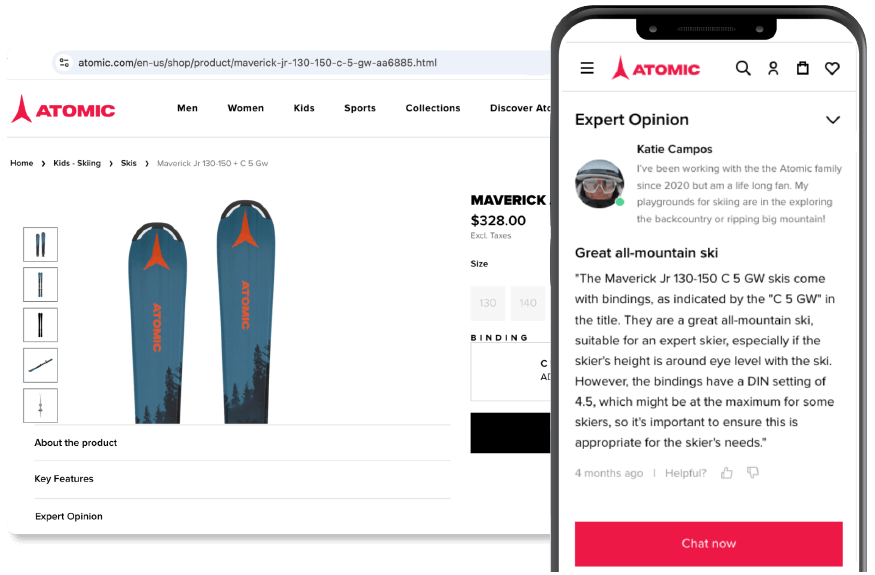
UCP is another acceleration event for AI commerce, and from what we have seen with our clients, community-driven, structured, AI-readable content is a great step towards brands staying discoverable in AI-Powered commerce.
Conclusion:
UCP is a clear signal that commerce is moving deeper into AI-driven discovery and checkout. As this shift accelerates, visibility will depend less on traditional page rankings and more on whether an AI can confidently select, explain, and recommend a product.
The strongest near-term advantage comes from getting the fundamentals right: structured product data, machine-readable PDPs, and credible experience-based content that answers real shopper questions. Brands that act early are likely to compound visibility and demand as AI-powered shopping becomes the default.
At GUURU, we help brands get content like that. Find out exactly how we can do it for your brand here - Community Content solution.
Want to explore how we can help you and your brand with AI-visibility? Let’s talk.
Urban Kopitar, Marketing & Sales enablement specialist
As a marketing & sales enablement specialist, Urban helps translate GUURU’s solution into clear, compelling stories that show the real value it creates for e-commerce brands. Since joining GUURU in 2024, Urban has focused on enabling sales and marketing campaigns that highlight how GUURU helps clients build trust, answer shopper questions, and create content that boosts AI visibility and drives conversion. Follow Urban on LinkedIn.
Common questions about UCP and AI-powered commerce
What is Google's Universal Commerce Protocol (UCP)?
Google's Universal Commerce Protocol (UCP) is an open-source standard, launched in January 2026, that lets AI shopping assistants and online stores communicate directly. It gives AI agents one standardized interface for product discovery, comparison, checkout, and order tracking, without a custom integration for each retailer. When a shopper decides to buy inside an AI result, UCP completes a secure transaction right in the conversation.
Will AI-powered shopping reduce traffic to my product pages?
It can. Shoppers increasingly get product specs, reviews, and pricing straight from an AI answer and buy through a protocol like UCP without ever opening the product page, and roughly 60% of Google searches already end without a click to an external site. The sale can still happen, but brands lose direct site engagement and the upsell and cross-sell moments that come with it, so being selected by the AI answer becomes the priority.
How can e-commerce brands prepare for UCP?
Start with three fundamentals: make product pages machine-readable with structured data and clean markup, add human, experience-based content that AI systems can reuse, and answer the comparison, fit, and use-case questions shoppers actually ask. As visibility shifts from ranking pages to being selected by an AI answer, credible first-hand content is what helps AI confidently recommend a product. Brands that act early tend to compound visibility as AI-powered shopping becomes the default.
Follow us on: